
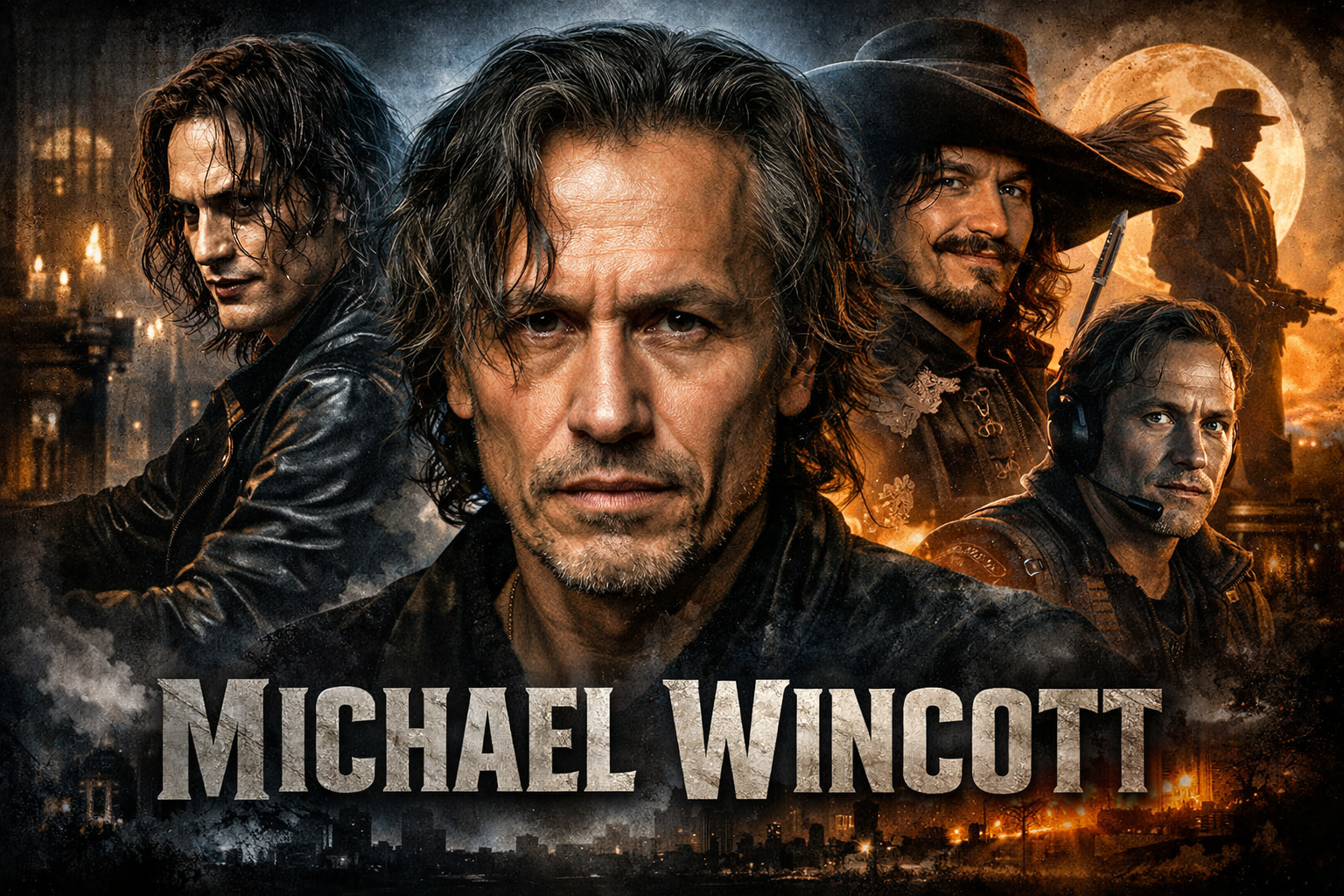
In the pantheon of Hollywood character actors, few have carved out such a singular niche as the one defined by a voice that feels like smoke curling from a back-alley cigar, laced with gravel and quiet menace. Michael Wincott’s delivery—deep, raspy, and impossibly textured—has become synonymous with cinematic darkness, turning supporting roles into unforgettable portraits of villainy, eccentricity, and moral ambiguity. Whether sneering as a medieval henchman or monologuing as a cyberpunk crime lord, his vocal instrument elevates every scene, making audiences lean in even as they recoil. Over four decades, this Canadian performer has lent his unmistakable timbre to Hollywood’s most shadowy figures, proving that sometimes the scariest thing on screen isn’t the monster itself but the voice that commands it.
Born on January 21, 1958, in Scarborough, a working-class suburb of Toronto, Michael Wincott grew up in a household that blended English pragmatism with Italian passion. His father, a steamfitter who later became a teacher through night classes, instilled a love of literature and determination. His mother, who hand-made ravioli on Sundays, taught patience and the sacred joy of craft. With an older brother, Jeff Wincott, who would also pursue acting and martial arts, the stage was set early. Young Michael fell in love with cinema, taking drama classes in high school and earning a BA from Victoria University at the University of Toronto. In 1982, supported by Canadian arts grants, he enrolled at the Juilliard School in New York City on a full scholarship, graduating in 1986. There, he honed his craft in Shakespeare, Sam Shepard, and intense contemporary works, performing roles like Teddy in When You Comin’ Back, Red Ryder? and Tilden in the school’s landmark production of Buried Child.
Post-Juilliard, Michael Wincott quickly immersed himself in New York’s vibrant theater scene. He originated the role of Kent in Eric Bogosian’s Talk Radio at Joseph Papp’s Public Theater in 1987, a performance that caught Oliver Stone’s eye and led to the film adaptation. He shared stages with legends, originating Stubbs opposite John Malkovich in Shepard’s States of Shock. These formative years built the fearless commitment that defines his work: total immersion, whether playing a stoned metal fan or a tormented soul. Early screen roles in Canadian TV like Earthbound (1976) and The Littlest Hobo, followed by guest spots on Miami Vice and Crime Story, kept him busy, but it was the move into feature films that revealed his true calling.
The early 1990s marked Michael Wincott’s breakthrough into mainstream consciousness. Collaborations with Oliver Stone proved pivotal: a haunting turn as a bedridden Vietnam veteran in Born on the Fourth of July (1989), followed by Paul Rothchild, the Doors’ producer, in The Doors (1991). But it was his portrayal of Guy of Gisbourne in Robin Hood: Prince of Thieves (1991) that introduced his voice to millions. As the sneering, ambitious cousin to Alan Rickman’s Sheriff of Nottingham, Wincott delivered lines with a venomous hiss that made every threat feel personal. His physicality—long hair, sharp features, and that rasping baritone—created a perfect foil to Kevin Costner’s heroic Robin, turning what could have been a stock villain into a memorably slimy antagonist.
What sets Michael Wincott apart is not just presence but that singular vocal quality. His deep, raspy voice, often described as gravelly and smoke-worn, carries an inherent gravitas that screams “danger” even in quiet moments. It’s not a shout; it’s a whisper that cuts through noise, layered with intelligence and poetic menace. Directors have repeatedly cast him as villains because the voice does half the work: it suggests a character who has seen too much, survived too much, and now wields words like weapons. In voice-over work, this quality shines even brighter. As the Prophet of Truth in Halo 2 (2004), he brought religious zealotry to life with booming, otherworldly conviction. As the skeletal horseman Death in Darksiders II (2012), his tones conveyed ancient weariness and dry humor. Scroop, the treacherous alien pirate in Disney’s Treasure Planet (2002), slithered with sinister sibilance thanks to that unmistakable rasp. These performances prove the voice isn’t a gimmick—it’s an instrument of storytelling that adds layers of complexity to even animated or digital characters.
No role better exemplifies the power of Michael Wincott’s voice than Top Dollar in The Crow (1994). As the gothic crime lord ruling Detroit’s underworld, he didn’t just chew scenery—he devoured it with flair. Dressed in flowing black, long hair cascading, Wincott’s Top Dollar quotes poetry, philosophizes about pain, and orchestrates chaos with lines delivered in that signature drawl: “Childhood’s over the moment you know you’re gonna die.” The voice transforms a flamboyant villain into something almost tragic, a man who romanticizes his own darkness. Opposite Brandon Lee’s vengeful Eric Draven, every confrontation crackles because Wincott’s delivery sells absolute conviction in his twisted worldview. Critics and fans alike cite it as one of the 1990s’ most magnetic antagonist turns, where the vocal performance elevates the entire film’s heightened reality.
The 1990s and early 2000s became Michael Wincott’s golden era of dark characters. In Kathryn Bigelow’s Strange Days (1995), he played music mogul Philo Gant, a sleazy industry shark whose oily charm hides ruthlessness—the voice dripping contempt during moments of betrayal. As Frank Elgyn, the cocky mercenary captain in Alien Resurrection (1997), he brought swagger and doomed bravado to Ridley Scott’s franchise, his rasp cutting through the sci-fi tension before the xenomorphs strike. In Along Came a Spider (2001), opposite Morgan Freeman, Wincott portrayed Gary Soneji, a meticulous kidnapper. Here the voice shifts registers: no longer bombastic like Top Dollar, but coiled and precise, a spider’s whisper that makes the psychopathy feel intimate and terrifying. The restraint showcases range—proving the gravel isn’t limited to scenery-chewing but can underpin quiet, calculated evil.
Further demonstrating versatility, Michael Wincott took on Armand Dorléac, the sadistic warden in The Count of Monte Cristo (2002), whose cruelty is matched only by the vocal relish in every taunt. In Seraphim Falls (2006), as Hayes, he added moral complexity to a revenge western. Even in non-villainous turns, the voice commands attention: as eccentric cinematographer Antlers Holst in Jordan Peele’s Nope (2022), he delivers monologues about capturing the unknowable with a weathered wisdom that grounds the horror. His uncredited role in Ghost in the Shell (2017) and hacker Adrian Cross in 24: Live Another Day (2014) continued the pattern of intelligent, shadowy figures who speak with authority.
Beyond the screen, Michael Wincott maintains a low profile, prioritizing art over celebrity. He plays multiple instruments—drums, guitar, harmonica, piano—and has contributed to projects by frequent collaborator Julian Schnabel. His elegance off-screen (sharp suits, thoughtful demeanor) contrasts the rogues he portrays, underscoring a deliberate separation between performer and persona. He has expressed admiration for peers like Anthony Hopkins and a desire to work with Isabelle Huppert, always choosing roles that challenge rather than paychecks. Recent work, including the groundbreaking portrayal of transgender character Georgina in the Swedish series Veni Vidi Vici (2017), shows a willingness to stretch boundaries.
Michael Wincott’s legacy lies in redefining what a “voice actor” means in live-action cinema. In an era of visual spectacle, his performances remind us that sound—specifically that raspy, hypnotic cadence—can haunt long after the credits roll. He isn’t ubiquitous, yet every appearance feels eventful. Fans scour filmographies for hidden gems, knowing that wherever Michael Wincott appears, darkness gains a compelling, unforgettable voice.
FAQ
Who is Michael Wincott? Michael Wincott is a Canadian character actor born in 1958 in Toronto, renowned for his deep, raspy voice and portrayals of complex, often villainous characters in film, television, and video games.
What makes Michael Wincott’s voice so distinctive? His gravelly, smoke-infused baritone conveys menace, intelligence, and poetic depth, making even simple dialogue feel layered with threat or gravitas. It has naturally led to typecasting in dark roles while allowing surprising range.
What is Michael Wincott’s most famous role? Top Dollar in The Crow (1994), the flamboyant crime lord whose monologues and presence opposite Brandon Lee defined 90s gothic villainy.
Which directors has Michael Wincott worked with frequently? Oliver Stone (Talk Radio, Born on the Fourth of July, The Doors) and Julian Schnabel have cast him multiple times, drawn to his intense commitment.
Has Michael Wincott done voice acting? Yes, notably as the Prophet of Truth in Halo 2, Death in Darksiders II, and Scroop in Treasure Planet, where his voice adds epic weight to animated and game characters.
Is Michael Wincott still acting? Yes. His most recent major role was Antlers Holst in Jordan Peele’s Nope (2022), and he continues selective work in film and television.
What other notable dark characters has Michael Wincott played? Guy of Gisbourne (Robin Hood: Prince of Thieves), Gary Soneji (Along Came a Spider), Armand Dorléac (The Count of Monte Cristo), and Philo Gant (Strange Days).
Does Michael Wincott have any siblings in the industry? Yes, his brother Jeff Wincott is also an actor known for roles in Night Heat and action films.
Why does Michael Wincott often play villains? His unique vocal timbre and intense screen presence make him ideal for characters who operate in moral gray areas or embody outright darkness, though he has shown range in non-villainous parts.
Where can fans learn more about Michael Wincott? His official website michaelwincott.org offers updates, while film databases like IMDb detail his extensive credits.